
St Anthony Torment by the Demons, c. 1487, was painted by Michelangelo when he was only 13. The panel, 18 x 12 inches, is warped as happens to many panels over time.
The Torment of Saint Anthony is a small panel painting which was recently discovered to have been painted by Michelangelo in 1487/88. Intensive cleaning in 2008/9 led experts to believe that Michelangelo painted it when he was 12 or 13 years of age. Only four easel paintings by Michelangelo are known, and this one of is in North America, at Fort Worth's Kimbell Art Museum.
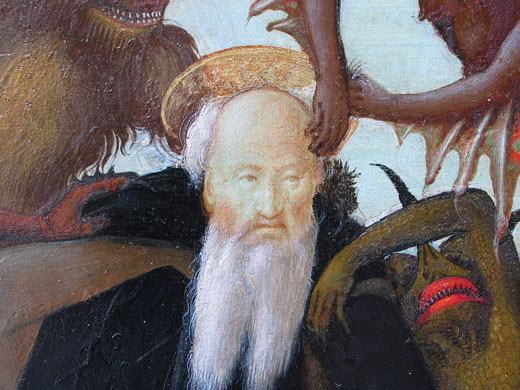
Michelangelo's St. Anthony looks remarkably calm despite the demons who are scratching him
St. Anthony was an early Christian of the 4th century who lived as a hermit for many years. According to his biographer, the rigorous asceticism practiced by St Anthony in the Egyptian desert allowed him to float in the air, where he was attacked by devils trying to beat him to the ground. Anthony defeated these demons on more than one occasion, but not without a big struggle. It is not at all surprising that a young Michelangelo would have been attracted to this subject, because the artist always seemed to be battling his own internal demons, as the poetry he wrote and certain sculptures of slaves he made later in life would suggest.

Schongauer's, masterly engraving, St. Anthony Tormented by Demons, c. 1480, gave inspiration to the young Michelangelo
Michelangelo copied an engraving by a German artist, Martin Schongauer, who was Europe's greatest practitioner of printmaking at that time. Schongauer used a vivid imagination and great technical ability to show light, shadow and texture. These beasts are composite creatures of fanciful reptiles, fish and flying monsters, who scratch, pull and club the holy man. Schongauer left the landscape minimal, a small edge of rocks in the lower right-hand corner which describe the mountain he lived on in isolation. Saint Anthony seems to be suspended in the air, in a radiating, circular composition. Schongauer used short dots or stipples to get his deepest shadows into the small metal plate used for engraving.We don't know the date of
 Schongauer's engraving--perhaps about 1480--but we know that his prints traveled throughout Europe. Michelangelo's biographers said that he made a painting after a Schongauer print when he was 13, and this new attribution fulfills that void in our knowledge. This connection also shows the important role of prints in spreading artistic ideas and iconography, with the engraving passed into Italy from Germany.I have seen the Schongauer original in the print room of the National Gallery and its details are incredible. No wonder the young genius was impressed.
Although Michelangelo borrowed many details
from the great German engraver, he went to
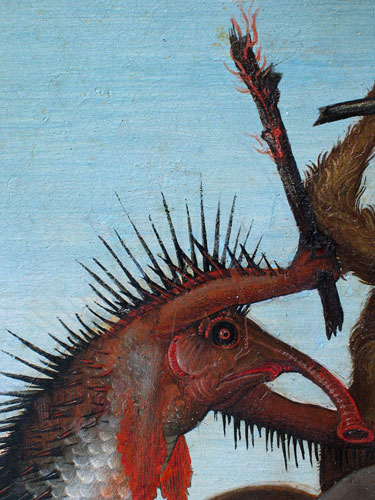
the fish market to observe. According to the
Kimball Art Museum, Michelangelo scraped away
lines of paint in the body of the fish-like creature,
revealing the primer beneath the paint in the
parallel lines of hatching.
 early white as it hits the horizon. The cool colors of the background and the low horizon line allow the figures to come forward and stand out with warm colors. This setting may be more reminiscent of the Arno in Florence than the Nile River, but European artists of the time were not familiar with the desert.
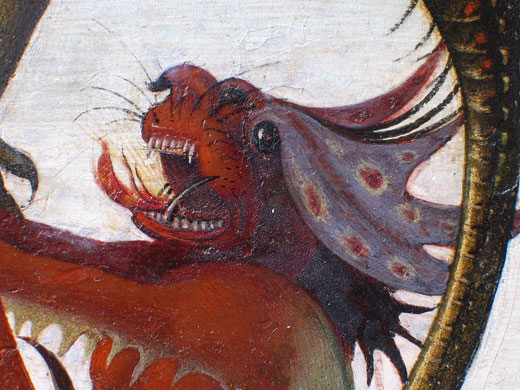
Photos above and right were taken by the Kimball to AP. This demon was painted in tempera and oil with magnificent detail. Color changes and the meticulous line technique are visible.
His mouth is ferocious.
His mouth is ferocious.


