Showing posts with label 19th century Art. Show all posts

Thursday, February 21, 2013

Looking Up: Skyscapes of the Civil War


Frederic Edwin Church, Meteor of 1860, is in the collection of Judith Filenbaum Hernstadt
Photos of the asteroid and a meteor which hit in Russia this past week reminded me of Frederick Edwin Church's painting of a meteor, now on view in the Smithsonian American Art Museum's exhibition, The Civil War and American Art.  This month we celebrate President's Day, Black History Month, and Spielberg's film of Lincoln in the Oscars, while the exhibition presents the historical and sociological aspects of the civil war as interpreted by artists of that time.   Many paintings and photographs on display tell those stories, but there's also a sub-theme of landscape as metaphor.  The scenery of two Hudson River School artists, Church and Sanford Robinson Gifford, present geological and astronomical wonders with deeper meanings.
  
Church's Meteor of 1860 connects to Walt Whitman's poem in Leaves of Grass, Year of the Meteors (1859-60).  While Whitman's poem spoke of John Brown's rebellion and the election of Abraham Lincoln, it also described "the comet that came unannounced out of the north flaring in heaven," and "the strange huge meteor-procession dazzling and clear shooting over our heads.  (A moment, a moment long it sail'd its balls of unearthly light over our heads, Then departed, dropt in the night, and was gone;)  

Church painted two large meteors followed by a trail of smaller sparks whose trail runs parallel to the earth.  Like Whitman's description, his vision also appeared at night; it lit up sky in pink and cast a glowing reflection on the water.  He wrote about the event he had seen from his home in the Hudson River Valley, Catskill, New York on July 20, 1860.  Could he have seen this rare event as an omen?

Frederic Edwin Church, Natural Bridge, Virginia, 1852 collection of the Fralin Art Museum, University of Virginia
The earliest painting by Church in the Smithsonian exhibition is The Natural Bridge, Virginia, a geological formation in Virginia's Shenandoah Valley, which George Washington had surveyed and Thomas Jefferson had owned at one time.  His painting pulls our eyes upward to the  meticulously painted detail of the rock against white clouds and a brilliant blue sky.  Another story is told towards the bottom of the painting, where a black man explains this geographic wonder to a seated white woman, putting him in the authoritative position.
Frederic Edwin Church, Icebergs, 1861, from the Dallas Museum of Art

In 1859, Church had traveled by boat from New York to Labrador in search of icebergs.  He exhibited one result,  Icebergs, in New York on April 24, 1861, two weeks after war had broken out at Fort Sumter.  Church responded to the national strife, renaming the painting The North—Church’s Picture of Icebergs, thus signaling his political stance. Church allocated all exhibition fees to a fund established to support the Union Soldiers’ Fund.  The large, impregnable iceberg is said to represent the North itself.  Church also may have wished to commemorate the Battle of Fort Sumter and signal his sympathies in another well-known painting owned by the Smithsonian American Art Museum, Our Banner in the Sky.
Frederic Edwin Church, Cotopaxi, 1862, oil on canvas, Detroit Institute of Arts, Founders Society Purchase, Robert H. Tannahill Foundation Fund, Gibbs-Williams Fund, Dexter M. Ferry Jr. Fund, Merrill Fund, Beatrice W. Rogers Fund, and Richard A. Manoogian Fund. The Bridgeman Art Library
Church traveled worldwide in his exploration of nature, natural wonders and exotic landscapes.  In 1862, he painted the Cotopaxi volcano in Ecuador.  Volcanoes are frequently seen as harbingers of war and upheaval.   Frederick Douglas had said in 1861, "Slavery is felt to be a moral volcano, a burning lake, a hell on earth."  Cotopaxi, along with Icebergs, is one of the four large paintings which may be seen as allegories of the causes and events of the Civil War.

Church, Aurora Borealis, 1865, in the Smithsonian American Art Museum
Church painted the northern lights in 1865 based on sketches provided by explorer Israel Hayes' sketches from a voyage to Labrador.  Aurora Borealis is an expansive view of nature in blue, green yellow, orange and red.  The halo of lights makes the sky look grand, while a boat shrinks next to its magnificence.    Generally the northern lights were interpreted as omens of disaster, but fortunately the war ended during the year in which it was painted.
Frederic Edwin Church, Niagara Falls, 1857, Corcoran Gallery of Art, Washington, DC

There are other important paintings by Church in Washington, DC, including the National Gallery's El Rio de Luz.  The Corcoran Gallery of Art owns Niagara Falls, 1857, above.  During the 19th century, lithographs of this painting circulated the country at a time when travel was not easy and photography was not widespread.  It's worth going to the Corcoran to see the painting.  A gorgeous rainbow rises through the mist and spray, but is only visible by surprise when one stands in front of the real painting, not computer reproduction.  Frederic Church can be thanked for painting and interpreting the art of nature and for reminding us of mother nature's greatness.

Wednesday, July 25, 2012

Roofs, Towers and Balconies in Gaudi's Barcelona


The rich and fertile imagination of Catalan architect Antoni Gaudí (1852-1926) is seen all over the city of Barcelona.  Gaudí was a part of Modernista in Barcelona, a Romantic design movement related to Art Nouveau    His curved lines and organic shapes were probably inspirations to the Surrealist painters from Catalonia, Joan Miró and Salvador Dalí.


Two homes at the entry to Parc Güell are sometimes described as Hansel and Gretl Houses
       
                  Gaudí designed a expansive public park in Barcelona, Parc Güell, originally to be like English gardens and to include a housing development which did not sell.  His curves and points are a delight to explore, as I did in a visit several years ago.  The colorful lizard tiles adorning a huge staircase doubles as a fountain.   There are several pavilions, gates, curving walls and benches.   The Gaudí House Museum, where the architect once lived,
is also in this park. 

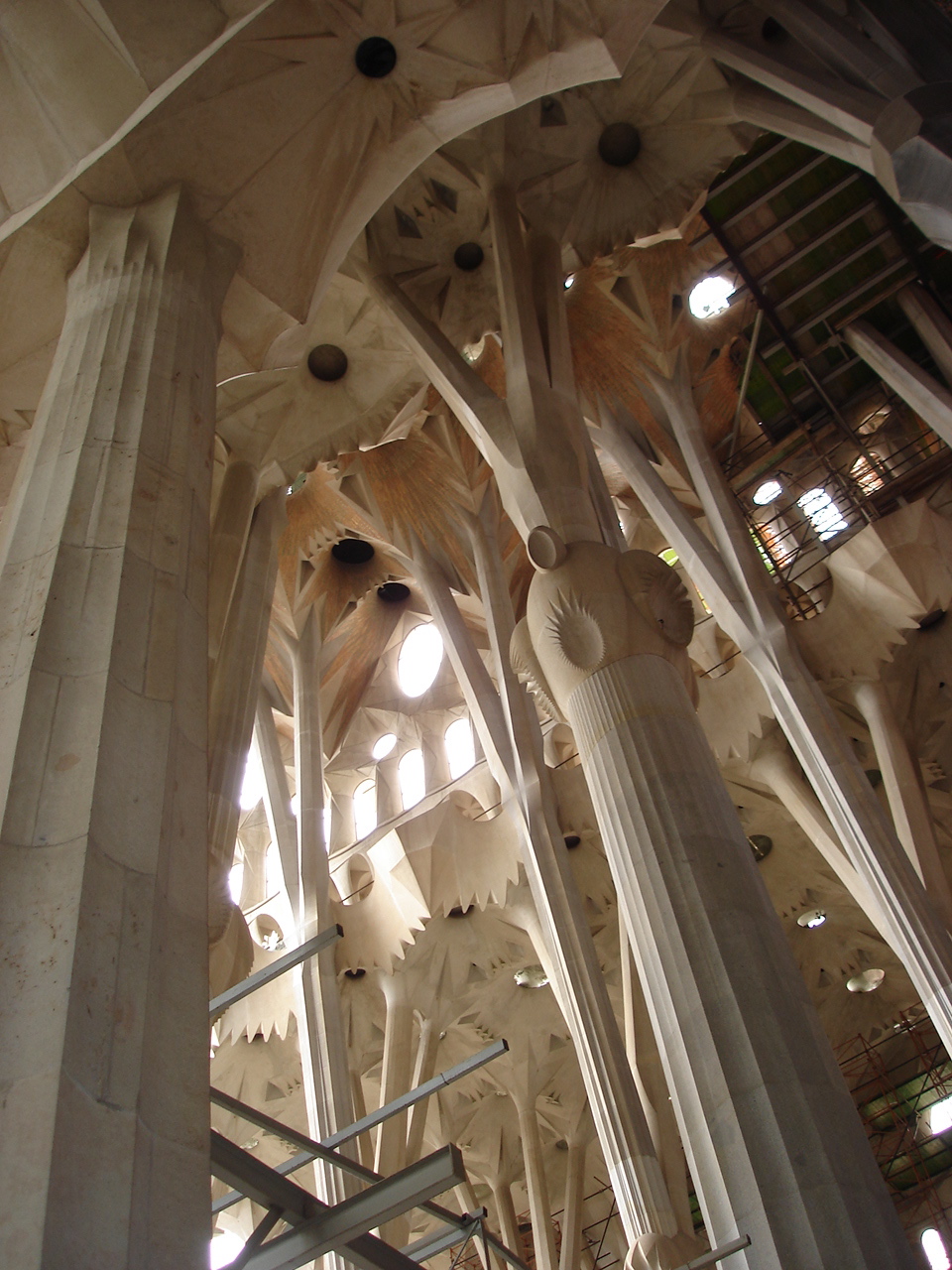
       Gaudí worked consistently on La Sagrada Familia from 1883 until his death, even living in a room within the building.  It has been taking more than 130 years to build and is expected to be completed by  by 2026--a hundred years after his death.  When I was there 7 years ago, much of the exterior shell was done.  In the end, it will have 18 towers and will rise 568 feet (170 meters) high. Its style combines the Gothic style with curvilinear Art Nouveau forms.
Gaudí was not only a great sculptural designer, but he was a genius of mathematical calculations.  He designed pointed arches for the Sagrada Familia, as in the Gothic style, but he figured out how to do it without the need for buttresses.   A modern computer program was able to determine that Gaudí arches are in the shape of parabolas.   
Gaudi's apartment buildings are fascinating for their shapes.  The Casa Milà, above, is said to imitate the waves of the sea, but locals have nicknamed it "La Pedrera,"  (the quarry).  Nature is the major inspiration.   

There is no better place to explore the fertile imagination of Antonio Gaudí then by looking from the rooftops. Whimsical biomorphic shapes at Casa Milà actually hide the building's utilities (pipes and ductwork) sculptural and cast iron designs.  The rooftop of Casa Milà becomes like a sculptured landscape to climb up, down, around and explore. Torre Agbar, the city's newest architectural icon by Jean Nouvel, is visible in the distance from inside an arch on top of that roof.

Whimsical faces, left, are vent covers pointing into the sky from the roof Casa Milà in Barcelona, perhaps Gaudí's most famous apartment building, left.


Gaudi's animation continues in another apartment building, Casa Batlló, below, where the balconies form masks........Casa Batlló has a rich surface of tiles, multicolored on the facade, but shaped like the scales of a dragon on the roof. Next door is Casa Amatller, by modernista architect Puig i Cadafalch.

            When lit at night, Casa Batlló's roof forms the body of a dragon, while a cross-shaped tower suggests the triumph of St. George over the dragon, or a victory of the cross over death and sin.

Thursday, April 19, 2012

Cross-Culturalism: Symbols of Mt. Fuji and the Eiffel Tower


Some of Henri Riviere's "36 Views of the Eiffel Tower." are in the Phillips' exhibition, Snapshot: Paintings and Photography, from Bonnard to Vuillard.  Five Metro stops away, the Smithsonian's Sackler Gallery is hosting an exhibition of Katsushika Hokusai's "36 Views of Mt. Fuji."   The Cherry Blossom Festival just celebrated the100th anniversary of Japan's gift of cherry trees  to Washington, DC, a capital city based on French urban design patterns. These exhibitions coincided with that event.


The top of the Eiffel Tower seen beyond the leaves is from Henri Riviere's 36 Views of the Eiffel Tower, its Frontispiece,
                           published in 1902.  Hokusai's 36 Views of Mt. Fuji, 1830-1832, inspired him.  The scene below, Mt. Fuji 
                                                     from Goten-yama has Spring cherry blossoms opening to a distant view of the peak.

The Sackler exhibition has selected the most vivid images available of Hokusai's woodblock prints and the colors are vibrant.  Blues predominate, but most  prints have at least 4 other hues.  Riviere's images are printed as color lithographs with more neutral color harmonies.  French artists admired Japanese woodblock prints and Riviere owned at least 800 of them. The Phillips' exhibition--definitely worth the visit--also has small paintings and many photographs by Post-Impressionist artists such as Edouard Vuillard, Pierre Bonnard, Maurice Denis, George Hendrik Breitner, Henri Evenepoel and Felix Valloton.

Both artists create different atmospheric effects, including the effects of wind, snow and various cloud formations. In many prints by each artist, the subjects, Mt. Fuji or the Eiffel Tower, are subordinated to other scenery.  Yet, Riviere used Hokusai's examples as inspiration rather than imitation.

Through rooftops and chimneys of Paris' many buildings we vaguely see the Eiffel Tower. A cat pokes through the diagonal zigzag of lines in the foreground as a dog runs away. Their silhouettes remind me
that Riviere did shadow plays for
 Le Chat Noir (the Black Cat).
Warehouses line a canal to form diagonal lines which lead  first, to Edo Castle, then to  Mt. Fuji, on the upper left corner,  (No 31 - Nihonbashi at Edo)

A large Mt. Fuji dominates the upper left, as a strong wind blows.  In this Autumn view, the people look
small compared to the force of the wind  (No. 18 - Sunshū Ejiri, in Suruga Province). Both
Hokusai and Riviere take the viewers through a yearly cycle of changing
weather conditions.  Hokusai's work dates to 1830-32.


Riviere also creates the sensation of Autumn wind surrounding a lonely man on a park bench. The
 Eiffel Tower stands directly above him.
Riviere spent a year watching the building of the Eiffel Tower.  During that time, he was able to go up into the construction and take photographs from the inside out.  Twelve of these photos are in the Phillips' 
exhibition, along with the lithograph above based on one of those pictures
The Phillips' exhibition compares these prints to photographs Riviere shot of workers constructing the Eiffel Tower. Riviere's primary profession was as a theatre set designer for Le Chat Noir, where he created shadow plays. As an artist, he is less well-known than Hokusai, although there is something magical about his style, perhaps a reflection of his work with silhouettes in the theatre and with photography. His prints were published in 1902 several years after he had taken the pictures of the Eiffel Tower. 

Hokusai is one of Japan's greatest artists.  There are two more exhibitions of paintings and screens by Hokusai in the Freer Gallery of Asian Art, which holds the world's largest collection of Hokusai and is attached to the Sackler Gallery. The rarely-seen Boy Viewing Mt. Fuji, ink on silk, is in a medium too fragile for continuous display, but it is included with the Hokusai paintings. 

It is an interesting to see that Hokusai, as an eastern artist, identifies with the power of pure nature, a volcanic mountain which dominates the Japanese landscape, while the western artist's symbol is a man-made construction, built for the World's Fair of 1889 and still a dominant symbol of Paris today.  

Hokusai's Boy Viewing Mt. Fuji, 1846, is a peaceful painting which expresses the grandeur of Mt. Fuji in color and ink on silk.  It is part of the Smithsonian's Freer Gallery of Asian art and will be on view until June 24, 2012 . 


Sunday, December 5, 2010

Why the Hudson River School Still Amazes


Thomas Cole, Sunset on the Arno, 1837, is at the Museum of the Shenandoah Valley until January 23. The exhibition, organized by the Westmoreland Museum of American Art, is from a private collection. Whispy clouds hover above, almost like angels.

Forty paintings from the Hudson River School of painting glow in the Shenandoah Valley, in the Museum of the Shenandoah Valley, Winchester, VA. Certainly this location has some resemblance to the Hudson River Valley and these paintings would naturally resonate in the community. Just as the 19th century artists centered mainly in New York and New England hoped to capture and hold onto the natural beauty of their unspoiled nature, the Shenandoah Valley still offers a resting place from too much human development. Entitled "Different Views of Hudson River Painting," the paintings will be in Winchester until January 23.

Jasper Francis Cropsey, The Narrows of Lake George, in the Hudson River Museum. A smaller, view of Lake
George with similar colors is on view is in the in the Museum of the Shenandoah Valley

In this two-room exhibition, many pristine paintings are arranged amongst poetry and quotations by Walt Whitman, William Cullen Bryant and others. The four seasons, many sunsets and other wonders of nature are on view. These paintings capture views we occasionally see in the mountains or countryside in those moments of nature's most beautiful light and color. I was particularly drawn to Jasper Francis Cropsey's radiant, reflecting color in Lake George, reminding me of the beautiful autumn that has just passed. Much if its appeal is that this painting and several others allow us to remember something and then hold onto it.

John William Casilear, Quiet River (Genesee), 1874. Often there are usually more cattle than people in the Hudson River paintings.

The majority of paintings are small and intimate; brushstrokes are minute and very detailed. People and animals, if depicted, are extremely small to show the grandeur of the natural world. The air is clean, often hazy, and the water is totally placid. We are invited into contemplation.

There are majestic views of Niagara Falls and Mount Washington, but also simple scenes of unknown places such as John William Casilear's Quiet River (Genesee),1874. There is nothing intellectual about the exhibition, only the opportunity for reverie in peaceful, pastoral places. Thomas Cole, founder of the Hudson School and painter of the Journey of Life series in Washington's National Gallery, often painted his landscapes as allegories, but there doesn't seem to be an underlying message in this Italian scene, Sunset on the Arno--unless the clouds are seen as angels.

Laura Woodward, Adirondeck Woodland with Deer, has an infinite variety of greens, from very light to dark. The two deer are barely shown against the daylight around the bend of a stream and under the tall trees on the right.


The entire exhibition helps us understand why the Hudson River School is still admired. Alexis Rockman, a contemporary New York painter featured in this blog's next entry was influenced by the Hudson River School.This distinctive American style of painting was important from the 1830s to 1880s. Impressionism in France had a much bigger influence on modernism and is usually more popular, but these artists--and there are so many of them-- deserve a long look and a lot of our respect.

At home I have a small painting on a plate, done in the Hudson River style by my great-grandmother, as gift to my great-grandfather It is signed on the reverse, "From Helen to James, painted between Xmas and New Year's 1889.

Washington museums also have several paintings of the Tonalists who came after the Hudson River School and were generally more painterly. These artists used more layers and show greater influence from the techniques of French painters, particularly from the Barbizon School. The Tonalist painters of moonlight scenes, offer a nice comparison with the sunsets of Hudson River painters---less color but perhaps even more evocative of moods. These paintings include several by Ralph Albert Blakelock at the National Gallery, Phillips, Corcoran and Smithsonian American Art Museum, as well as paintings by George Inness.
Here is a blog devoted to the Hudson River School: http://circa1855.blogspot.com/


Thursday, April 8, 2010

Torrents of Rain and Gusts of Wind

Jean-Francois Millet, The Gust of Wind, 1871-73, National Museum of Wales

It's disappointing that the Corcoran exhibition, From Turner to Cezanne, had to be taken down early as a precaution over environmental concerns......I was counting on going Friday, April 9, three days after it abruptly closed. What am I missing? A spectacular collection from the National Gallery of Wales, little-known paintings of well-known artists that are seldom seen in the US..................... Torrents of Rain and Gusts of Wind.....


Vincent Van Gogh, Rain, Auvers, 1890, from the National Museum of Wales
Vincent Van Gogh's suns, stars and flowers from sunny Provence express the intensity he experienced in the South of France. But in May, 1890, he moved north of Paris to Auvers-sur-Oise and painted Rain, Auvers in July. This painting conveys a heavy impact of rain with Van Gogh's uncommon ability to combine actual texture of the paint itself with the tangible, tactile sense of objects painted. I really wanted to see Rain, Auvers to experience the downpour. Exaggerated or not, Van Gogh has the power to create a reality that makes us feel its presence more keenly. But the rain in this painting, deliberate gashes to the canvas surface, warns of a downpour more powerful than rain, the artist's impending doom--he shot himself July 29th.

Even more than the Van Gogh, I was also looking forward to seeing paintings by Daumier and Millet, two mid-19th century French painters who are often overlooked, particularly in their gifts of great draftsmanship. Van Gogh seems to have admired them. One of Millet's paintings from this Davies Collection at the National Museum of Wales is The Gust of Wind, 1871-73. Millet conveys the full fury of a storm in the countryside. He captures the birds, leaves and branches with jagged, undulating brushstrokes. Along with the wind, his tree is uprooted and the birds, man (a shepherd whose sheep can barely be seen) and flock scatter in a fury, as the luminous colors of daylight poke through the background.

It is commonly understood that Van Gogh's paintings of The Sower were inspired by Millet's The Sower. No doubt Van Gogh knew many paintings by Millet and shared his appreciation for man's connection to the land. He adopted Millet's expressive lines, but thickened the contours and turned up the volume on color. Brandon, one of my students, was amazed to discover the wind that Van Gogh captured in The Olive Orchard, now on view in the Chester Dale Collection at the National Gallery of Art. Certainly Millet was one of Van Gogh's most inspiring teachers, along with the Japanese artist Hiroshige, whose woodcuts gave Van Gogh the motif of diagonal cuts for rain.

In May and during most of the summer, this exhibition travels to Albuquerque Museum of Art in New Mexico. However, while the O'Keeffe exhibition remains at the Phillips until May 9th, its worth seeing the weather photographs of Alfred Stieglitz and comparing them to paintings about weather.
Ando Hiroshige, Rain Shower on Ohashi Bridge, 1857
woodcut, at the Library of Congress. The rain, treated like gashes in the wood, influenced the gashes in "Rain,Auvers"


Van Gogh, The Olive Orchard, 1889, Chester Dale Collection,National Gallery of Art, Washington, DC


detail, The Gust
of Wind, shows
how Millet's lines influenced Van Gogh