Sunday, November 11, 2012

Chihuly's Glass Garden in Seattle

The art of glass is a place where artistic vision, exquisite craftsmanship and landscape design come together.  Currently, there's an exhibition of Chihuly Glass at the Virginia Museum of Fine Arts, Richmond, which may be a distance to go see, but worth it!  It's the third major installation in a US Museum, following exhibitions in San Francisco and Boston. One can expect huge crowds and colorful visions that are full of surprise.

Chihuly's Garden of Glass opened last spring in Seattle. 
The Seattle museum is adjacent to the Space Needle and Frank Gehry's Experience Music.   Over Labor Day weekend, I had the pleasure of going to Seattle when it wasn't raining, thanks to my niece for choosing the right time to have her wedding on Bainbridge Island.


September is lovely in Seattle, and when the sun is out, the full spectrum of the colors can be appreciated.  It may not be as bright in winter, but if I had to live there through the rainy winters, the colors  probably would give me some solace.  Chihuly is a native of Tacoma and it is a wonder that he developed such color and technique in this climate. Chihuly studied glass blowing on the island of Murano, near Venice, Italy, one of the few places known for making exquisite glass. Glass blowing techniques go back to the Egyptians, and the Romans learned from them.   Surprisingly, there are many other glass artists and craftsmen working today, but we really have to credit Dale Chihuly for bringing back artistry, craftsmanship and popular interest into the art of glass.

Radiant complementary colors abound.The Garden of Glass includes outdoor and indoor spaces.
One time I had gone to the Chihuly's Bridge of Glass in Tacoma on a rainy winter day.  I tried, but it was impossible to appreciate the array of colors through the gloom of a rainy winter day.  From November to April, the rain is constant in Washington.

There are many rooms and sections of the indoor museum, including a section of Native American weavings which have influenced the artist.  To me the Glass Forest, below,  is the most impressive interior room.  Circles, swirls, and organic shapes compete for attention against a black background.


Before leaving the building, flowers of glass hang from the ceiling.     Light, color and reflection give a endless array of design.

The Chihuly Garden of Glass is permanent but the Virginia Museum exhibition will last until February 10th.  Going along with its exhibition, the museum made and recently this video of Dale Chihuly in his studio.  He obviously needs a host of workers in the Walla Walla Studio to make these magnificent organic visual wonders. 

Wednesday, July 25, 2012

Roofs, Towers and Balconies in Gaudi's Barcelona


The rich and fertile imagination of Catalan architect Antoni Gaudí (1852-1926) is seen all over the city of Barcelona.  Gaudí was a part of Modernista in Barcelona, a Romantic design movement related to Art Nouveau    His curved lines and organic shapes were probably inspirations to the Surrealist painters from Catalonia, Joan Miró and Salvador Dalí.


Two homes at the entry to Parc Güell are sometimes described as Hansel and Gretl Houses
       
                  Gaudí designed a expansive public park in Barcelona, Parc Güell, originally to be like English gardens and to include a housing development which did not sell.  His curves and points are a delight to explore, as I did in a visit several years ago.  The colorful lizard tiles adorning a huge staircase doubles as a fountain.   There are several pavilions, gates, curving walls and benches.   The Gaudí House Museum, where the architect once lived,
is also in this park. 

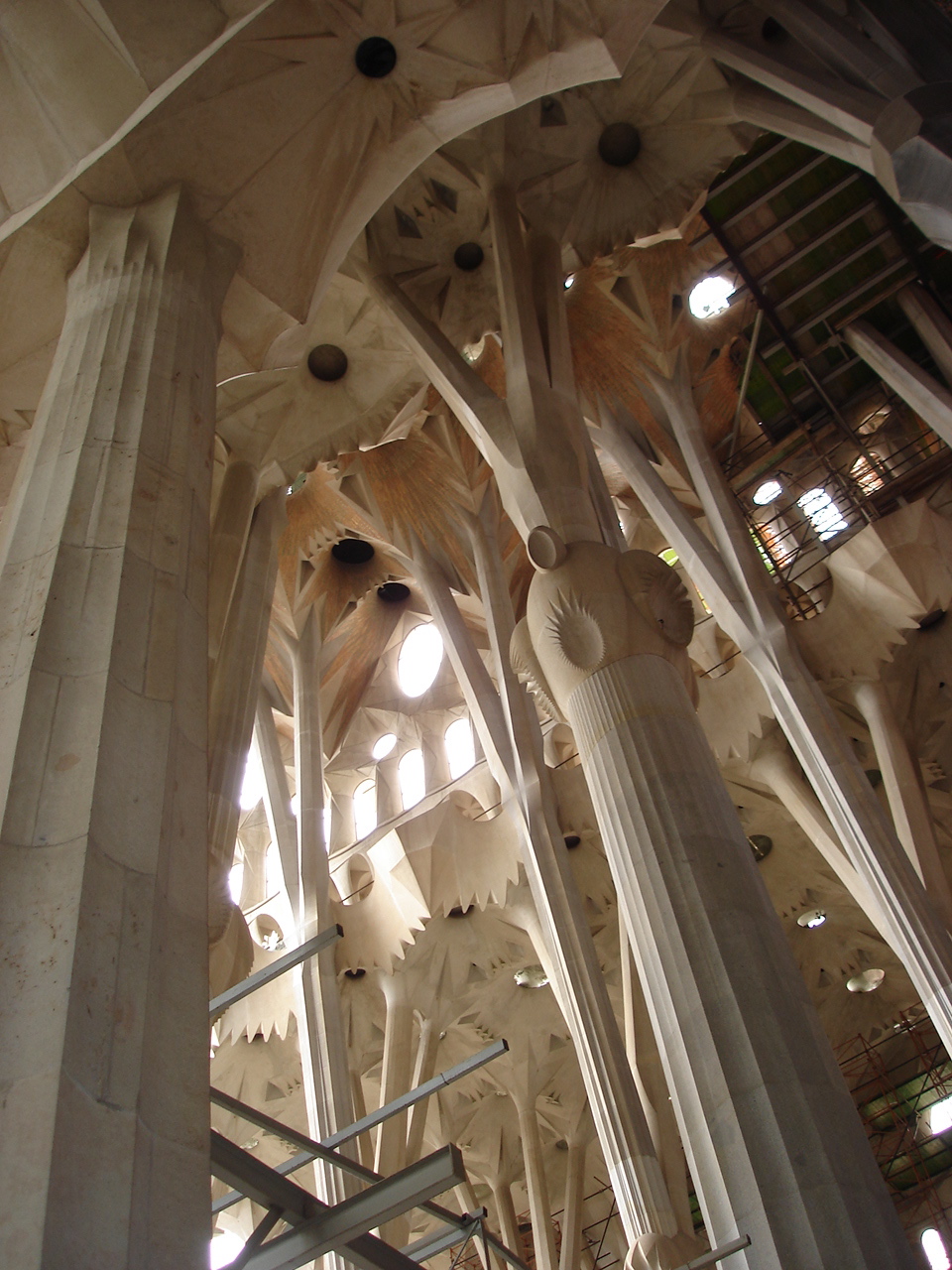
       Gaudí worked consistently on La Sagrada Familia from 1883 until his death, even living in a room within the building.  It has been taking more than 130 years to build and is expected to be completed by  by 2026--a hundred years after his death.  When I was there 7 years ago, much of the exterior shell was done.  In the end, it will have 18 towers and will rise 568 feet (170 meters) high. Its style combines the Gothic style with curvilinear Art Nouveau forms.
Gaudí was not only a great sculptural designer, but he was a genius of mathematical calculations.  He designed pointed arches for the Sagrada Familia, as in the Gothic style, but he figured out how to do it without the need for buttresses.   A modern computer program was able to determine that Gaudí arches are in the shape of parabolas.   
Gaudi's apartment buildings are fascinating for their shapes.  The Casa Milà, above, is said to imitate the waves of the sea, but locals have nicknamed it "La Pedrera,"  (the quarry).  Nature is the major inspiration.   

There is no better place to explore the fertile imagination of Antonio Gaudí then by looking from the rooftops. Whimsical biomorphic shapes at Casa Milà actually hide the building's utilities (pipes and ductwork) sculptural and cast iron designs.  The rooftop of Casa Milà becomes like a sculptured landscape to climb up, down, around and explore. Torre Agbar, the city's newest architectural icon by Jean Nouvel, is visible in the distance from inside an arch on top of that roof.

Whimsical faces, left, are vent covers pointing into the sky from the roof Casa Milà in Barcelona, perhaps Gaudí's most famous apartment building, left.


Gaudi's animation continues in another apartment building, Casa Batlló, below, where the balconies form masks........Casa Batlló has a rich surface of tiles, multicolored on the facade, but shaped like the scales of a dragon on the roof. Next door is Casa Amatller, by modernista architect Puig i Cadafalch.

            When lit at night, Casa Batlló's roof forms the body of a dragon, while a cross-shaped tower suggests the triumph of St. George over the dragon, or a victory of the cross over death and sin.